Search This Blog

Followers

Friday, September 22, 2017

A Multiplication Shortcut


Suppose I want to multiply 8 and 256.  I note that 8 × 256 = 23 × 28 = 211 = 2048.   I have turned multiplication into addition. A voice in my head says, “Hey, that could be a useful trick.”  Another voice says “What if you want to multiply 7 and 652? Stupid!”   It is true that 7 = bx or  652 = by have no whole number solutions (except the obvious and useless b = b1.)  But we do not have to restrict ourselves to whole numbers.

Consider the equations √10 × √10 = 10 and 100.5 × 100.5 = 101 = 10.  In these equations √10 and 100.5 have exactly the same job.  We can consider them equivalent.   Hence the exponent ½ (or 0.5) represents a square root.  Similarly  the exponent ⅓ represents a cube root. In general, the exponent n/m represents the mth root of a number to the power n. For example, 105/6 is the sixth root of 100 000.  Note that 100 000 = 105.

Lets look again at the product of 7 and 652.

P = 7 × 652

P = 10a × 10b = 10a+b.  

I want 7 = 10a and I want 652 = 10b. In other words I want the logarithms of 7 and of 652 in base 10.  By definition of a logarithm y = bx ó logb y = x.   Therefore 7 = 10a ó log10 7= a   and 652 = 10b ó log10 652= b.  The numbers a and b are 0.845 098 040 and  2.814 247 595 respectively.     

Therefore P = 10 0.845 098 040 +2.814 247 595  = 103.659345635 = 4563.999 = 4564  

Ok, that’s impressive. But where did you get log10 7= 0.845 098 040  and log10 652 = 2.814 247 595?  Agreed , that’s the hard part.  John Napier was the first person to calculate a table of logarithms. He published his table in the year 1614; after 20 years of work!  
Picture from https://math.stackexchange.com/questions/47927/motivation-for-napiers-logarithms
Napier's "invention was quickly and widely met with acclaim. The works of Bonaventura Cavalieri (Italy), Edmund Wingate (France), Xue Fengzuo (China), and Johannes Kepler's Chilias logarithmorum (Germany) helped spread the concept.”   https://en.wikipedia.org/wiki/History_of_logarithms
Napier’s original table did not use base 10.  A few years later Napier worked with Henry Briggs  to produce a table of common (base 10) logarithms.  Briggs continued after Napier died and published their table in 1624.
Picture from

Tuesday, June 27, 2017

Arnold Sunrise Problem


In a interview in 1995 the notable Russian mathematician Vladimir Igorevich Arnold  recalled a problem set  by his schoolteacher, I. V. Morozkin, when he (Arnold) was 11 or 12 years old. (An Interview with Vladimir Arnold)


“Two old women started at sunrise and each walked at a constant velocity. One went from A to B and the other from B to A. They met at noon and, continuing with no stop, arrived respectively at B at 4 p.m. and at A at 9 p.m. At what time was the sunrise on this day?”

Arnold says “I spent a whole day thinking on this.”  I presume, from Arnold’s statement, the sunrise problem was an extension problem  set for high achievers after they completed  routine exercises.  That Arnold spent a day thinking about the problem implies Mr Morozkin did not teach the class a technique to solve it. Even as an extension exercise the sunrise problem seems far beyond the curriculum for 11-12 year olds in most countries now or then. The year was 1949.  

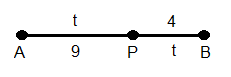
The sunrise problem seems to require fairly advanced abstract thinking at an age when Piaget believed that children were just making the transition from the concrete operational stage of development to the formal operation stage. Arnold said his solution was based on what  are “now called scaling arguments” and “came as a revelation.”  Did he draw something like this?


The women (lets us call them Ekaterina and Yelena) are walking at constant velocity.
Using Arnold's hint we can write VE = kVY. 
Rearranging, k= VE /VY .
Then from the diagram, or otherwise,  t/9 = 4/t.  Obviously, t = 6.
Sunrise occurs 6 hours before noon, that is  06.00 or 6 am.

Actually, I have omitted one step. (AP/t)/(AP/9) = (PB/4)/(PB/t ) But this seems trivial.

Saturday, May 13, 2017

Using Algebra and Geometry


Question      


In the regular hexagon below, compare the shaded area to the entire area. 

 There appear to be three tasks.

·         Find the grey area. 

·         Find the total area.

·         Compare the two results.

Where to start? It is often a good idea to make a rough sketch. 

Central congruent triangles


We don’t know if the hexagon has sides of 3 cm or 2 miles or ….  Actually it doesn’t matter.  Each of the sides is 1s.  Partition the hexagon into 6 identical equilateral triangles (One has been shaded pink).  The apothem (or “radius”) is the height of the pink triangle, h_p.


The area of the pink triangle can be found using A= 1/2  (side)(side)  sin (included angle).  Your calculation should show the area of a pink triangle is √3/4. Therefore the area of the entire hexagon is  6√3/4 .

The grey area


Now consider the grey triangle.  The sum of the interior angles is  180(n - 2)°=720°. Therefore one interior angle is 120°. The area of the grey triangle is 1/2  (side)(side)  sin (included angle) =                   1/2 (1)(1)  sin (120°) = √3/4.  
                                
Solution

The ratio of  kX to X  is √3/4  :  6√3/4  so k is 1 ∶ 6 =  1/6 .


Aha!


Is the figure below a cube or a hexagon?   Actually we can consider the hexagon to be the ‘projection’  (or shadow) of a cube.  Immediately, we see the shaded area is one-sixth of the total area.


Input: A cube(3-D shape) casts a shadow on a wall. Output: A regular hexagon (2-D shape) is partitioned into 6 congruent triangles.  Thanks to students S.H. and A.L. for partitioning the hexagon into congruent triangles.

Conclusion

When you have the answer, don't stop. A hard-won solution may prompt additional insight. 

Saturday, April 8, 2017

Using Your Question Bank


Open the  Acrobat Catalog Index.


A Search window opens.  Since I am looking for sequence questions I will type ‘nth term’.


Click Search.


Open a file by clicking on it, for example “ nth term of a different sequence is 4n – 2.”


By clicking on a few more search results you can quickly put together a quiz or test on the topic.


Create Your Own Question Bank

If you have a copy of Adobe Acrobat Professional you can create your own question bank from past year papers.  The bank you will create is 'bare-bones'.  It does not link to curriculum focus, level of difficulty,  answer keys or examiner reports.  With all those negatives, why bother? Mainly because the question bank itself runs on the free Adobe Acrobat.

1) Create a folder and copy all the PDFs you want to index to the folder.
2) Open Adobe Acrobat Professional.

3) Choose Advanced > Catalog....

4) Click New Index...

In Index Title, give your index file a name.
In Index Description, type a few words about the type of index.
Then browse for folders (Any folder nested under an included folder will also be indexed.)

Click OK.  you will be prompted to build.

Click Build, and specify the location for the index file. Click Save.  When complete you will see index build successful.


Acrobat Professional has created a file with a .pdx extension and a support folder, with file(s) with .idx extensions. The IDX files contain the index entries. These files are available to any user who wants to search the index.  

Note:
The procedure may vary slightly in a different version of Adobe Acrobat Professional.


Saturday, June 1, 2013

Making Sense of Variables

Some of us have no trouble with writing expressions or equations for word problems.  But we are in the minority.  Earlier today I was reading from a rather old (1980s) study on this very difficulty.  One might have hoped that in the 30 plus years since then, a pedagogical solution to the problem would have been found, but any algebra teacher can tell you that making sense of word problems remains traumatic for many children.
The following question (taken from Translation difficulties in Learning Mathematics, American Mathematical Monthly, v88 n4 p286-90 Apr 1981) was given to 47 (non-science) algebra students and 150 calculus students.
Write an equation for the statement, ‘There are six times as many students as professors at this university.’ Use S for the number of students and P for the number of professors. 
I was not surprised that more than half (57%) of the algebra students got this question wrong. But a large minority (37%) of the calculus students also had an incorrect answer.   According to the authors, the most common mistake was 6S = P.  When asked to explain their thinking, some students drew a picture like this:


The mathematics teacher might be frustrated that the requirement (or warning? or advice?) “Use S for the number of students…” was not followed.   Otherwise, the drawing should look like this:
 
The number of students = 6.
The number of professors   = 1
Obviously, 6 ≠1.  However,

Replace “The number of students” with S and “The number of professors” with P to obtain:
Make ‘S’ the subject of the equation by multiplying both sides by P.
Finally, obtain, S = 6P. 
Is this too much work for something that’s obvious? Perhaps the joke is on us:
The professor is giving a lecture and has made an assertion as part of his presentation. A student, not understanding the basis for the assertion asks why it is true. The professor responds that "It is obvious." Then the professor steps back, stares at the board and ponders for several minutes. Then he turns and walks out of the lecture hall. He is absent for a fairly long time  … Finally, just before the class is scheduled to end the professor reappears, and announces "Yes, it is obvious."


Saturday, April 20, 2013

Visualisation versus Algebra?


Here is a Primary 5 (Grade 5) word problem from Yan Kow Cheong in Singapore:
There are 100 chickens and rabbits altogether. The chickens have 80 more legs than the rabbits. How many chickens and how many rabbits are there? (http://www.singaporemathplus.net/1/post/2013/03/the-chickens-and-rabbits-problem.html ).    In ‘the West’ this sort of problem would not be attempted until the students have been taught algebra (i.e., y = mx + c, etc) so it would probably be a Grade 9 problem!   In a comment on another problem involving chickens and ducks, Kow-Cheong states that “the model heuristic is nothing but algebra in disguise. Instead of using the variable x, we use a unit, part or line to represent some unknown quantity ..[which] … allows us to use visualization to solve higher-order word problems.


The same author asks if we can use the bar method, or the Sakamoto method, to solve the following problem:  Mr. Yan has almost twice as many chickens as cows. The total number of legs and heads is 184. How many cows are there?

I must admit that my preferred technique for this sort of problem is algebraic. 
Let the number of cows be k.
Let the number of chickens be h.
Then h = 2k – x, where x is a ‘slack’ variable such that 0 < x << k.
Legs + heads = 184
(4k + 2h) + (k + h) = 184
Substitute for h.
(4k + 2(2k – x)) + (k + (2k – x)) = 184
4k + 4k – 2x + k + 2k – 2x = 184
11k – 3x = 184
11k = 184 + 3x.
Apparently, k < 20 and x is much less than k, so x might be 1, 2, 3 or 4.
Assuming x = 1
11k = 184 + 3 = 187
k = 187/11 = 17
Then h = 2k – x = 2(17) – 1 = 33.
Note that if x = 2, 3 or 4, k cannot be an integer but we obviously expect there to be a whole number of cows so the problem is solved.  Mr Yan has 33 chickens and 17 cows.  I do look forward to seeing the Sakamoto solution.

Wednesday, February 27, 2013

An Introduction to the Vector Equation of a Line


Given two different points we can always draw a line segment between them.  We can also sketch a line given just one point and a direction.  How?  The instructions are ‘hiding in plain view’ in the equation y = mx + c. Take, for example y = ½ x – 3. 
Please do not make a table of values for x and y.


Tables are slow and inefficient.  Remember, we only need one point!  Which point? The y-intercept.  For the equation y = ½ x – 3, start at the point (0, c) = (0, -3).   Now what?  From the gradient, m = ½,  we find that the rise is 1 and the run is 2. 
If the gradient is written as a fraction (½, 23/7, -4/3, …) the numerator is the ‘rise’ and the denominator is the run.  If, however, the gradient is written as a decimal number (0.5, 1.6, - 3.9, …) the given number is the ‘rise’ and the run is always ‘1’. Positive runs go to the right; negative runs to the left.  Positive rises go up; negative rises go down. 

With preliminaries out of the way, here is the line: Start at the y-intercept, sketch the run (running parallel to the x-axis) and then sketch the rise (rising parallel to the y-axis).  Label the end point, P.   Take a ruler and connect the y-intercept and point P.


You can explore with the Geogebra file “mx_plus_c” to vary intercept c and gradient m using the respectively labeled sliders.  Turn on the trace function for point P by right clicking on the point and selecting “Trace On”.  Move the c and m sliders to choose your desired y intercept and gradient. After you have chosen these parameters, go the pull-down menu, View and click “Refresh Views”. Finally, go to the xP slider and drag that button.  What happens?


The rise and run are continually refreshed, so the screen only shows the latest values, but we see all the previous values of point P.  The locus of point P is the required line. Ta Dah! 
Conclusion:
For many of you this essay merely re-stated the obvious.  However, the next installment will use very similar ideas to explain the vector equation of a line: 
p = q + kv .

Appendix:  Geogebra Construction
No.
Name
current value
1
Number, m
 a slider variable
m = 1.7
2
Number, c
 a slider variable
c = -1
3
Point, O
 the origin
O = (0, 0)
4
Point, I
(0, c)
I = (0, -1)
5
Vector, vectorc
Vector[point, point] = Vector[O, I]
vectorc = (0, -1)
6
Number, xp
 a slider variable
xp = 2.8
7
Vector run
Vector[point, point] = Vector[(0, c), (xp, c)]
run = (2.8, 0)
8
Vector rise
Vector[point, point] =Vector[(xp, c), (xp, c + xp times m)]
rise = (0, 4.76)
9
Point P
vectorc  + run + rise
P = (2.8, 3.76)
Created with GeoGebra

 A copy of the applet is stored on http://www.geogebratube.org/

Saturday, February 23, 2013

The Pentagram


The pentagram is an ancient symbol (http://mathworld.wolfram.com/Pentagram.html) , recently popularized by Dan Brown (http://www.danbrown.com/the-davinci-code/).   Mathematicians have analysed its properties since the time of Pythagoras.  (www.math.tamu.edu/~dallen/history/pythag/pythag.html)
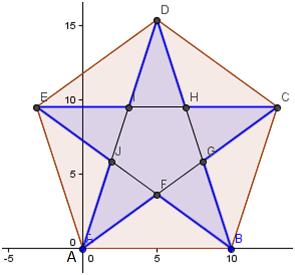
One such question is what is the area of the blue star below?


 Johnny decides to find the area of the large pentagon (ABCDE) and to subtract the area of the five (congruent isosceles) triangles, each coloured light brown above. ABF is one such triangle.
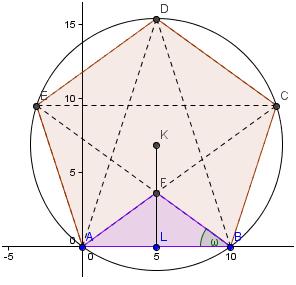
The exterior angle of a regular pentagon is 360°/5 = 72°. Hence each interior angle is 180° - 72° = 108°.  Angle EAB is one such angle so <EAB = 108°.  Call the centre of the pentagon K. Segment KA bisects angle EAB. Hence Angle KAB = ½ ×108° = 54°.


The area of the pentagon is 5 times the area of the green triangle.  The height  of the required triangle is 5 tan 54° = 6.88190…. Hence the area of the triangle is ½ (10)( 6.88190….) = 34.40954. The area of the entire pentagon is 5×34.40954. = 172.047.
                                                                           Each base angle of the highlighted isosceles triangle is ½ (180° -108°) = 36°.Hence, the height of the highlighted triangle is 5 tan 36° = 3.632712. Consequently  the area of the triangle is ½ (10)( 3.632712….) = 18.163563.  The area of all five triangles  is 5×34.40954. = 90.81781.


The area of the star is the area of the area of pentagon (ABCDE) minus the area of the five triangles; 172.047 - 90.817 = 81.2 units2 to 3 sig figs.
Mary takes a different approach.  She decides the area of the star is five times the area of the dart KAFB (shaded grey below).  A dart is simply an unusual kite.

The area of a kite is half the product of the diagonals = ½ (AB)(KF). Note that diagonal KF is inside the polygon and diagonal AB is outside the polygon; nevertheless the formula still holds. Diagonal AB is given (10 units). Hence, Mary only needs the length of segment KF =  5 tan 54°-  5 tan 36° = 5(tan 54°-   tan 36°) = 6.88190 - 3.632712 = 3.249188.
Mary calculates the area of the star = 5×½ (10)( 3.249188)= 25×3.249188 = 81.2 units2 to 3 sig figs.
Conclusion: Johnny and Mary both used the five-fold symmetry of the shape, both used the trigonometric ratio ‘tangent θ’, and both used the same angles (54° and 36°).  Hence their algebra is essentially the same. They only differed in the physical meaning they gave to the algebra. Johnny calculated the area of two triangles (ABK and ABF) whereas Mary calculated the area of the dart KAFB.  
Can you find another way to find the area of the star? Is it possible to find the area but avoid using trigonometry?  What about the mysterious number phi (http://en.wikipedia.org/wiki/Golden_ratio ).

Wednesday, February 13, 2013

Trigonometry Quiz


Give answers which are lengths correct to three significant figures.  Give answers in degrees correct to one decimal place.                                        
                                   
1. In the right-angled triangle MNO,   MO = 4.5 metres and angle MON = 32o.  Calculate the length of MN.                                    


2.            GHI is a right triangle.  GH  = 8 cm and HI = 7 cm.   Angle H = 90°. Calculate the size of angle HIG.    


3.   UVWX is a dart. 


a) Calculate the length of side UV.          nnnnnnnnnnnnnnnnnnnnnnnnnnnnnn                                                                                                             
b) Calculate the size of angle UXW.                                                                                                                                                                    
                                                                                                                                                                                                                           
                                                                                                                                                 
4. Square-based pyramid PQRST is shown in the diagram below.  All the edges are 3 cm in length.


a) Calculate the length of PR.                                                                                                                                                                                                                                                                                                               
b) Calculate the vertical height, MT.                                                                                                                                                                                                                        
c) Calculate the angle between PT and the base PQRS.