Search This Blog

Followers

Tuesday, June 27, 2017

Arnold Sunrise Problem


In a interview in 1995 the notable Russian mathematician Vladimir Igorevich Arnold  recalled a problem set  by his schoolteacher, I. V. Morozkin, when he (Arnold) was 11 or 12 years old. (An Interview with Vladimir Arnold)


“Two old women started at sunrise and each walked at a constant velocity. One went from A to B and the other from B to A. They met at noon and, continuing with no stop, arrived respectively at B at 4 p.m. and at A at 9 p.m. At what time was the sunrise on this day?”

Arnold says “I spent a whole day thinking on this.”  I presume, from Arnold’s statement, the sunrise problem was an extension problem  set for high achievers after they completed  routine exercises.  That Arnold spent a day thinking about the problem implies Mr Morozkin did not teach the class a technique to solve it. Even as an extension exercise the sunrise problem seems far beyond the curriculum for 11-12 year olds in most countries now or then. The year was 1949.  

The sunrise problem seems to require fairly advanced abstract thinking at an age when Piaget believed that children were just making the transition from the concrete operational stage of development to the formal operation stage. Arnold said his solution was based on what  are “now called scaling arguments” and “came as a revelation.”  Did he draw something like this?
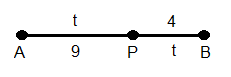

The women (lets us call them Ekaterina and Yelena) are walking at constant velocity.
Using Arnold's hint we can write VE = kVY. 
Rearranging, k= VE /VY .
Then from the diagram, or otherwise,  t/9 = 4/t.  Obviously, t = 6.
Sunrise occurs 6 hours before noon, that is  06.00 or 6 am.

Actually, I have omitted one step. (AP/t)/(AP/9) = (PB/4)/(PB/t ) But this seems trivial.

Saturday, May 13, 2017

Using Algebra and Geometry


Question      


In the regular hexagon below, compare the shaded area to the entire area. 

 There appear to be three tasks.

·         Find the grey area. 

·         Find the total area.

·         Compare the two results.

Where to start? It is often a good idea to make a rough sketch. 

Central congruent triangles


We don’t know if the hexagon has sides of 3 cm or 2 miles or ….  Actually it doesn’t matter.  Each of the sides is 1s.  Partition the hexagon into 6 identical equilateral triangles (One has been shaded pink).  The apothem (or “radius”) is the height of the pink triangle, h_p.


The area of the pink triangle can be found using A= 1/2  (side)(side)  sin (included angle).  Your calculation should show the area of a pink triangle is √3/4. Therefore the area of the entire hexagon is  6√3/4 .

The grey area


Now consider the grey triangle.  The sum of the interior angles is  180(n - 2)°=720°. Therefore one interior angle is 120°. The area of the grey triangle is 1/2  (side)(side)  sin (included angle) =                   1/2 (1)(1)  sin (120°) = √3/4.  
                                
Solution

The ratio of  kX to X  is √3/4  :  6√3/4  so k is 1 ∶ 6 =  1/6 .


Aha!


Is the figure below a cube or a hexagon?   Actually we can consider the hexagon to be the ‘projection’  (or shadow) of a cube.  Immediately, we see the shaded area is one-sixth of the total area.


Input: A cube(3-D shape) casts a shadow on a wall. Output: A regular hexagon (2-D shape) is partitioned into 6 congruent triangles.  Thanks to students S.H. and A.L. for partitioning the hexagon into congruent triangles.

Conclusion

When you have the answer, don't stop. A hard-won solution may prompt additional insight. 

Saturday, April 8, 2017

Using Your Question Bank


Open the  Acrobat Catalog Index.


A Search window opens.  Since I am looking for sequence questions I will type ‘nth term’.


Click Search.


Open a file by clicking on it, for example “ nth term of a different sequence is 4n – 2.”


By clicking on a few more search results you can quickly put together a quiz or test on the topic.