Search This Blog

Followers

Saturday, April 20, 2013

Visualisation versus Algebra?


Here is a Primary 5 (Grade 5) word problem from Yan Kow Cheong in Singapore:
There are 100 chickens and rabbits altogether. The chickens have 80 more legs than the rabbits. How many chickens and how many rabbits are there? (http://www.singaporemathplus.net/1/post/2013/03/the-chickens-and-rabbits-problem.html ).    In ‘the West’ this sort of problem would not be attempted until the students have been taught algebra (i.e., y = mx + c, etc) so it would probably be a Grade 9 problem!   In a comment on another problem involving chickens and ducks, Kow-Cheong states that “the model heuristic is nothing but algebra in disguise. Instead of using the variable x, we use a unit, part or line to represent some unknown quantity ..[which] … allows us to use visualization to solve higher-order word problems.


The same author asks if we can use the bar method, or the Sakamoto method, to solve the following problem:  Mr. Yan has almost twice as many chickens as cows. The total number of legs and heads is 184. How many cows are there?

I must admit that my preferred technique for this sort of problem is algebraic. 
Let the number of cows be k.
Let the number of chickens be h.
Then h = 2k – x, where x is a ‘slack’ variable such that 0 < x << k.
Legs + heads = 184
(4k + 2h) + (k + h) = 184
Substitute for h.
(4k + 2(2k – x)) + (k + (2k – x)) = 184
4k + 4k – 2x + k + 2k – 2x = 184
11k – 3x = 184
11k = 184 + 3x.
Apparently, k < 20 and x is much less than k, so x might be 1, 2, 3 or 4.
Assuming x = 1
11k = 184 + 3 = 187
k = 187/11 = 17
Then h = 2k – x = 2(17) – 1 = 33.
Note that if x = 2, 3 or 4, k cannot be an integer but we obviously expect there to be a whole number of cows so the problem is solved.  Mr Yan has 33 chickens and 17 cows.  I do look forward to seeing the Sakamoto solution.

Wednesday, February 27, 2013

An Introduction to the Vector Equation of a Line


Given two different points we can always draw a line segment between them.  We can also sketch a line given just one point and a direction.  How?  The instructions are ‘hiding in plain view’ in the equation y = mx + c. Take, for example y = ½ x – 3. 
Please do not make a table of values for x and y.


Tables are slow and inefficient.  Remember, we only need one point!  Which point? The y-intercept.  For the equation y = ½ x – 3, start at the point (0, c) = (0, -3).   Now what?  From the gradient, m = ½,  we find that the rise is 1 and the run is 2. 
If the gradient is written as a fraction (½, 23/7, -4/3, …) the numerator is the ‘rise’ and the denominator is the run.  If, however, the gradient is written as a decimal number (0.5, 1.6, - 3.9, …) the given number is the ‘rise’ and the run is always ‘1’. Positive runs go to the right; negative runs to the left.  Positive rises go up; negative rises go down. 

With preliminaries out of the way, here is the line: Start at the y-intercept, sketch the run (running parallel to the x-axis) and then sketch the rise (rising parallel to the y-axis).  Label the end point, P.   Take a ruler and connect the y-intercept and point P.


You can explore with the Geogebra file “mx_plus_c” to vary intercept c and gradient m using the respectively labeled sliders.  Turn on the trace function for point P by right clicking on the point and selecting “Trace On”.  Move the c and m sliders to choose your desired y intercept and gradient. After you have chosen these parameters, go the pull-down menu, View and click “Refresh Views”. Finally, go to the xP slider and drag that button.  What happens?


The rise and run are continually refreshed, so the screen only shows the latest values, but we see all the previous values of point P.  The locus of point P is the required line. Ta Dah! 
Conclusion:
For many of you this essay merely re-stated the obvious.  However, the next installment will use very similar ideas to explain the vector equation of a line: 
p = q + kv .

Appendix:  Geogebra Construction
No.
Name
current value
1
Number, m
 a slider variable
m = 1.7
2
Number, c
 a slider variable
c = -1
3
Point, O
 the origin
O = (0, 0)
4
Point, I
(0, c)
I = (0, -1)
5
Vector, vectorc
Vector[point, point] = Vector[O, I]
vectorc = (0, -1)
6
Number, xp
 a slider variable
xp = 2.8
7
Vector run
Vector[point, point] = Vector[(0, c), (xp, c)]
run = (2.8, 0)
8
Vector rise
Vector[point, point] =Vector[(xp, c), (xp, c + xp times m)]
rise = (0, 4.76)
9
Point P
vectorc  + run + rise
P = (2.8, 3.76)
Created with GeoGebra

 A copy of the applet is stored on http://www.geogebratube.org/

Saturday, February 23, 2013

The Pentagram


The pentagram is an ancient symbol (http://mathworld.wolfram.com/Pentagram.html) , recently popularized by Dan Brown (http://www.danbrown.com/the-davinci-code/).   Mathematicians have analysed its properties since the time of Pythagoras.  (www.math.tamu.edu/~dallen/history/pythag/pythag.html)
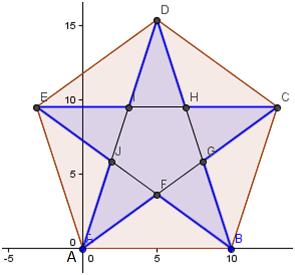
One such question is what is the area of the blue star below?


 Johnny decides to find the area of the large pentagon (ABCDE) and to subtract the area of the five (congruent isosceles) triangles, each coloured light brown above. ABF is one such triangle.
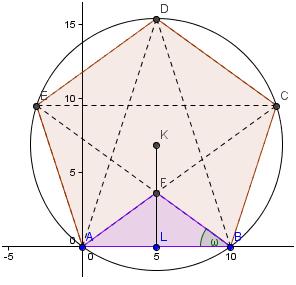
The exterior angle of a regular pentagon is 360°/5 = 72°. Hence each interior angle is 180° - 72° = 108°.  Angle EAB is one such angle so <EAB = 108°.  Call the centre of the pentagon K. Segment KA bisects angle EAB. Hence Angle KAB = ½ ×108° = 54°.


The area of the pentagon is 5 times the area of the green triangle.  The height  of the required triangle is 5 tan 54° = 6.88190…. Hence the area of the triangle is ½ (10)( 6.88190….) = 34.40954. The area of the entire pentagon is 5×34.40954. = 172.047.
                                                                           Each base angle of the highlighted isosceles triangle is ½ (180° -108°) = 36°.Hence, the height of the highlighted triangle is 5 tan 36° = 3.632712. Consequently  the area of the triangle is ½ (10)( 3.632712….) = 18.163563.  The area of all five triangles  is 5×34.40954. = 90.81781.


The area of the star is the area of the area of pentagon (ABCDE) minus the area of the five triangles; 172.047 - 90.817 = 81.2 units2 to 3 sig figs.
Mary takes a different approach.  She decides the area of the star is five times the area of the dart KAFB (shaded grey below).  A dart is simply an unusual kite.

The area of a kite is half the product of the diagonals = ½ (AB)(KF). Note that diagonal KF is inside the polygon and diagonal AB is outside the polygon; nevertheless the formula still holds. Diagonal AB is given (10 units). Hence, Mary only needs the length of segment KF =  5 tan 54°-  5 tan 36° = 5(tan 54°-   tan 36°) = 6.88190 - 3.632712 = 3.249188.
Mary calculates the area of the star = 5×½ (10)( 3.249188)= 25×3.249188 = 81.2 units2 to 3 sig figs.
Conclusion: Johnny and Mary both used the five-fold symmetry of the shape, both used the trigonometric ratio ‘tangent θ’, and both used the same angles (54° and 36°).  Hence their algebra is essentially the same. They only differed in the physical meaning they gave to the algebra. Johnny calculated the area of two triangles (ABK and ABF) whereas Mary calculated the area of the dart KAFB.  
Can you find another way to find the area of the star? Is it possible to find the area but avoid using trigonometry?  What about the mysterious number phi (http://en.wikipedia.org/wiki/Golden_ratio ).