Search This Blog

Followers

Tuesday, February 15, 2011

An Add Maths Vector Question


"In this question, i is a unit vector due east and j is a unit vector due north. At 0900 hours a ship sails from the point P with position vector (2i + 3j) km relative to an origin O. The ship sails north-east with a speed of 15 √2 km h–1.

i) Find, in terms of i and j, the velocity of the ship.     [2]

ii) Show that the ship will be at the point with position vector (24.5i + 25.5j) km at 1030 hours.       [1]


iii) Find, in terms of i, j and t, the position of the ship t hours after leaving P.                [2]

At the same time as the ship leaves P, a submarine leaves the point Q with position vector(47i – 27j) km.  The submarine proceeds with a speed of 25 km h–1 due north to meet the ship.

iv) Find, in terms of i and j, the velocity of the ship relative to the submarine.                  [2]

v) Find the position vector of the point where the submarine meets the ship.                [2]
                  CIE ADD MATHS summer 2008 paper 1 question 10"

The velocity of the ship:                                                                                        

North-east has a compass bearing (angle with the y-axis or North axis) of 045°. Therefore the angle with the x-axis (i.e., East axis) is also 45° and the velocity vector forms an isosceles right triangle.  Recall that the
 sine and cosine of 45° are both 1/√2. Keep this exact value: do not use the approximation 0.707.


Since ship and sub both start with ‘s’, I have somewhat arbitrarily decided to use for the names of the boats their respective starting points in the equations which follow. ‘P’ subscripts denote the ship; ‘Q’ subscripts denote the submarine.

VP = 15 √2 (1/√2) i +  15 √2 (1/√2) j

VP = 15  i +  15 j


The position of the ship t hours after leaving P:                                      

Displacement of the ship from origin, O  = ship’s original position + velocity * time

DP = P +t vP
DP = (2 i + 3 j) + (15 t i + 15 t j)
DP = (2 + 15 t) i + (3 + 15 t) j


The  ship will be at the point (24.5i + 25.5j) km at 1030 hours      

Note that I did part iii) first and then returned to part ii) as a special case.

At 1030, one and a half hours have elapsed since 0900, so substitute t = 1.5 into the equation above.

DP = (2 + 22.5) i + (3 + 22.5) j

DP =  24.5 i + 25.5 j


The velocity of the ship relative to the submarine.                                            

The velocity of P relative to Q is
vP – vQ = (15  i + 15  j) – (0 i + 25 j)
= 15  i – 10 j


The position vector of the point where the submarine meets the ship.                                                                                                                                                                                                               
For the ship to meet the sub, the two position vectors (or using the vocabulary of physics, their displacements) must be equal for the same value of time, t.
DP = DQ                         
When vectors are equal, all their components are equal. Thus, the coefficients of i and of j for both displacements are equal.
Equating the coefficients of i we get:
2 + 15 t  = 47 
15 t = 45                              
t = 3                                    
Likewise, equating the coefficients of j we get:
3 + 15 t = 25 t – 27
30= 10 t
t = 3
As the t values are equal, we can be sure the ship meets the sub at 1200 noon.  I.e., noon is 3 hours after the starting time of 0900. (As an aside; had the solutions produced different values for t, we would have concluded the system was inconsistent, i.e., that the ship and the sub did not meet.)
The ship and sub meet at:
DP = DQ =  47 i + (25(3) – 27) j
= 47 i + 48 j


An alternate method:

The velocity of submarine relative to itself is vQ – vQ  = 0. ( A bolded zero is a zero vector.)

Hence the relative position of Q remains as 47 i – 27 j.  We can 'pretend' that Q is not moving.  We do this all the time: we pretend the earth is not whizzing through space at thousands of km per second!  For the ship to meet the sub, its relative position must also be 47 i – 27 j.

We can calculate the Relative Position of P (with respect to Q) at time t using:
Relative Position of P  = the ship’s original position + Relative velocity * time

47 i – 27 j = (2 i + 3 j) + (15 t i – 10 t j)
47 i – 2 i – 15 t i = 3 j + 27 j – 10 t j
45 i– 15 t i = 30 j – 10 t j
(45 – 15 t) i = (30 – 10 t) j

Since i and j are in different directions this vector equation can only have the solution  0 = 0.
With scalars, the equation 1x = 1y implies x = y. However vector equations such as1i = 1j or 2i = 2j, declare an impossibility, since perceptible movement East is never equal to any amount of movement North. However we do allow a movement of 0 units East to equal a movement of 0 units North.

We require that (45 – 15 t) i = 0 i .  Hence t = 3.
We also require that (30 – 10 t) j = 0 j .  It is confirmed that t = 3.

(Had we found two different values of t, the system of equations would have been inconsistent-implying no meeting of the ship and sub. As the system is consistent the ship and the sub do meet.)

The actual (not relative) position of ship P at 12 noon is found is found just as we found its position at 1030.

Displacement of the ship P from origin, O  = ship’s original position + velocity * time

DP = vP
DP = (2 i + 3 j )+ (15 t i + 15 t j)
DP = (2 + 15 (3)) i + (3 + 15 (3)) j
DP = 47 i + 48 j

Monday, February 14, 2011

An Add Maths Function Question

1 a) Express 2x2 – 8x + 5 in the form a(x + b)2 + c where a, b and c are integers. CIE ADD MATHS summer 2002, paper 1, question 11


Recall that (x + b) 2 = x 2 + 2bx + b 2. A common mistake is (x + b) 2 = x2 + b 2.  As a simple example, suppose x = b = 1. Then (1 + 1) 2 ≠ 1 2 + 1 2.

Multiply (x + b) 2 through by a and add c: a(x + b) 2+ c = ax 2 + 2abx + ab 2 + c.

By polynomial identity, the squared terms of both forms can be equated, likewise the linear terms are equal, and finally the constant terms are also equal:

2x2 = ax 2     -->     a = 2
– 8x = 2abx     --> b = -2
5 = ab 2 + c    -->  c = -3


Thus 2x2 – 8x + 5  = 2(x + (-2))2 + (-3)
 

This sort of problem can also be solved by “completing the square,” which will be the subject of another blog. The equation y = 2x2 – 8x + 5 is written in expanded form, while y = 2(x – 2) 2 – 3 is the same parabola written in vertex form. As the squared term (x – 2) 2 cannot be negative, its minimum is 0 and this occurs when x = 2. Then, y = 2(0) 2 – 3 = -3. More generally a parabola when written as y = a(x – h) 2+ k has vertex (h, k). As an aside, the CIE examiner is deliberately muddying the waters by using the parameters a, b, and c in his writing of the vertex form. These particular letters are more commonly associated with the expanded form and its accompanying quadratic formula.


b) The function f is defined by f : x 2x2 – 8x + 5 for the domain 0 ≤ x ≤ 5.
i) Find the range of f.

From the expanded form (ax 2+bx +c) the y-intercept of the parabola is 5, the parabola is open 
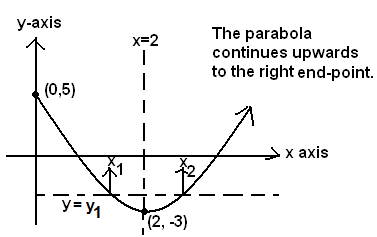
 upwards (as a = 2 > 0) and from the vertex form (a(x - h)2 + k) its vertex is (2, -3). A rough sketch follows:


The minimum y-value is -3. The left end-point maximum is y = 5. The right endpoint of the domain is x = 5 and the corresponding value of y is 2(5– 2) 2 – 3 = 18 – 3 = 15. Thus the range of function f is -3 <= y <=15.


ii) Explain why f does not have an inverse.


Notice the horizontal line y = y1. For one value of y there exist two values of x. The function is not 1-1. Therefore it cannot have an inverse.


The function g is defined by g : x 2x2– 8x + 5 for the domain x ≥ k.

iii) Find the smallest value of k for which g has an inverse.


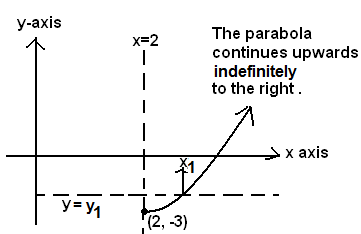
As seen above the graph of g should begin at the vertex and go upwards and right indefinitely. The domain is 2 ≤ x < infinity . Hence k = 2.


iv) For this value of k, find an expression for g–1. 


g(x) = y = 2x2– 8x + 5    Given
x = 2y2– 8y + 5    To find the inverse, swap ‘x’ and ‘y’.
x = 2(y – 2) 2 – 3     Switch to the (already known) vertex form, for easier simplification.
x + 3 = 2(y – 2) 2
½(x+3) = (y – 2) 2   
sqrt{½(x+3)} =  sqrt { (y – 2)2 }   Square-root both sides; on the right, cancel the square and the square-root.
2 + sqrt {½(x+3)} = y = g–1   
g–1(k) = g–1(2) = 2 +sqrt { ½(2+3)}    We were asked to find an expression; there is no requirement to simplify.


You can download a slightly better formatted copy of this essay:

https://docs.google.com/document/d/1BK0mQeZikXhQFvy1222JAHfiMb50OKtfEn43injDUIw/edit?hl=en#

Saturday, January 22, 2011

Pythagoras in 3-D


Figure 1. Box ABCDEFGH

For some curious reason I want to know the distance from the bottom left front corner (point A) to top right back corner (point G) in the box above. I also want to know the angle made by the line AG with the bottom of the box. 
 
I will start by unfolding the box to make the flat shape below. Mathematicians call an unfolded shape a net. When the box is unfolded some single points (such as G and H) get represented as two distinct points (G and G’; H and H’).

Figure 2. A net of the same box.

ABCD is a rectangle forming the bottom of the box. B is obviously a right angle and and are both acute angles. The diagonal AC cuts the rectangle ABCD into two congruent (or equal) right-angled triangles, one of which is ABC (shaded light green above).

What may not be so obvious is that ACG’ (shaded light blue) must also be a right angled triangle! See Figure 3 below. It appears that ACG’ is a single straight line. If that is so, external angle ACG’ is 180° and consequently + would equal 180°, also. Since we already know that is acute, it appears that must be an obtuse angle. 

Figure 3. A "zoomed-in" view of Figure 2 with extraneous detail erased.

We all know the saying, “A picture is worth a thousand words.” But folk wisdom is often contradictory and you probably have also heard, “You can’t believe everything you see.” Remember that ABCDEFGH is a 3-dimensional box. AB is the length of the box. BC is the breadth of the box. Length and breadth are dimensions, at 90° to each other. Together they form a horizontal plane. Now look back at Figure 1. Line CG (or equivalently CG’) is the vertical height of the box, so it must make a 90° angle to the horizontal plane! In other words, angle BCG’ is a 90° angle (between the horizontal and the vertical). Since AC is also horizontal, it follows that ACG’ (the angle also labeled ) must also be a 90° angle. How can I assert that AC is also horizontal? It’s simple: any line drawn on a horizontal plane will be a horizontal line, when considered with respect to the third dimension.
 
A glance at the diagram below might be helpful. The x-, y- and z-axes are all mutually perpendicular. Representing 3-D space on a 2-D plane requires that some 90 degree angles appear other than they really are.


Figure 4. Reminding you of 3-D Cartesian axes.

By now you may believe I have wandered rather too far from the main point. But now its time to wrap up.

Figure 5. The triangles are drawn so that angle B and angle C can both be seen to be right angles, although the three dimensional look has been lost.

x2 + y2 = c2 ①                               (c is the hypotenuse of right triangle ABC).
c2 + z2 = d2 ②                               (c is a merely a leg of right triangle ACG; d is the hypotenuse).
Here’s the “magic.” Substitute for c2 in equation ②:
 
x2 + y2 + z2 = d2. ③          Very neat!  I  can solve for d without actually calculating either c or c2.

As a bonus, I can do some trigonometry. The angle between the base of the box and the line AG is and can be found using any of the inverse sine, cosine or tangent functions, for example = tan-1 (z÷c).

In conclusion, my curiosity was satisfied because I looked at the problem from a different perspective. If I actually make a box ABCDEFGH it is obvious that angle ACG is 90°.  When I drew the net, I lost one dimension and the 90° angle became a 180° angle!  Was it wrong to draw the net?  No - the purpose of the net was to show that line segment AC has two roles to play. It can be regarded as the hypotenuse of one triangle but is merely a leg of another triangle.  This dual role led to the substitution that produced equation ③, which extends the 2-D Pythagorean equation into 3-D.